Friday, August 14, 2009

Fifteen years...thirty decks: Zur's Weirding


My brother and I often discussed the possibility of using Zur's Weirding as the centerpiece of a tourney-quality deck. We always came to the same conclusion:

Any great deck with Zur's Weirding in it would probably be better without Zur's Weirding in it.

Nonetheless, we built various decks around the card. One of my favorites featured discard effects and creature recursion. Around the same time period, I built a creature control and recursion deck based around Necroplasm. Neither deck was super great, but they used many of the same cards so I combined them to create this "fun" deck.

3x Zur's Weirding
4x Elves of Deep Shadow
3x Birds of Paradise
3x Spike Feeder
1x Golgari Grave-Troll
3x Putrefy
4x Shambling Shell
4x Last Gasp
4x Brain Pry
4x Hypnotic Specter
3x Necroplasm
2x Plague Boiler
2x Simic Growth Chamber
2x Dimir Aqueduct
10x Swamp
8x Forest

Monday, August 10, 2009

Balazar: Travel and Weather


For some fantasy rpg campaigns I would just handwave, improvise, or summarize overland travel and weather (e.g. the Zanzer Campaign). Such factors were supremely important in the narrative of the Lewis & Clark expedition. Therefore, I think the Balazar campaign can be enriched by using a consistent system for determining how far the party travels in a day and what weather greets them.

Like with provisions management, I'd prefer such systems to be simple and abstract. Conveniently and coincidentally, the Griffin Mountain setting book describes simple systems for determining weather and overland travel rates. I've transcribed the travel rules here, nearly verbatim:

Three modes of movement are available to any party moving through the wilderness: search, travel, and pursuit.

Search mode involves a slow an methodical checking of the entire hex area. Use this mode for hunting or treasure seeking, and occasionally for mapping.

Travel mode is normal movement through the terrain, making a good, but not strained, speed. Travel mode always follows paths when available.

Pursuit mode is fast movement. It is exhausting, and can only be maintained for two days. Pursuit mode maybe used by both the pursued and the pursuers.

Each party traveling through a wilderness has a number of movement points equal to the movement class of its slowest member. This number, which will range from 1 to 12, will also be the number of movement points available to a party per day.

(An unmounted and unencumbered party has 8 movement points per day. A mounted and unencumbered party has 12 movement points per day.)


The Movement table gives the movement point cost per hex (5 miles) depending on the terrain and movement mode.

(Essentially, one movement point equals the ability to travel five miles at top speed on a path in clear terrain. The table extrapolates that base value to other terrain and modes.)

Movement point cost per hex (5 miles)

TerrainPursuitTravelSearch
Clear246
Forest4812
Hills61218
Mountains81624

Modifiers:
Along Path x.5
Boat upriver x1.5
Boat downriver x.5
Short Portage +4
Long Portage +8
Cross Minor River +1 (Assumes no boat. Has risk of accident.)
Cross Major River +2 (Assumes no boat. Has risk of accident.)

The modifiers are guidelines. Specific situations may affect travel less or more severely. Especially when dealing with rivers, the weather and season have a major effect on travel difficulty. The weather system is simply a large table to randomly determine general weather conditions each day, based upon the previous day's weather and which season it currently is.

The setting has five seasons, four of which correspond to the real world seasons, and a fifth season that is exceptionally stormy, with mythical origins and implications. More info here.

Thursday, August 6, 2009

Truck Mix Disc: The Dubliners


The pride of my cassette tape trove has long been a collection of Irish pub songs by The Clancy Brothers and Tommy Makem. Earlier this summer I decided I wanted something like that on CD, so I picked up a three-disc set by The Dubliners. I've condensed those down to this one disc of my favorites.

Back in the 1960's popular folk music came to be dominated by lily-throated minstrels lamenting the cruelty of man. The Dubliners went the other direction: grunting folk songs primarily about drinking and wenching.

1. Seven Drunken Nights
2. Rising of the Moon
3. Wish I was back in Liverpool
4. The Fairmoye Lasses and Sporting Paddy
5. Molly Maguires (live)
6. Biddy Mulligan
7. The Musical Priest/Blackthorn Stick
8. I'm a Rover
9. Maids When You're Young Never Wed An Old Man
10. Nancy Whiskey
11. A Pub With No Beer
12. Seven Deadly Sins
13. The Parting Glass
14. Poor Paddy on the Railway
15. Kelly, The Boy from Killan
16. The Breeze (live)
17. Cork Hornpipe (live)
18. Whiskey on a Sunday
19. Dirty Old Town
20. Whiskey in the Jar (live)
21. The Old Triangle
22. The Galway Races
23. Battle of the Somme/Freedom Come All Ye
24. Smith of Bristol
25. The Beggar Man
26. School Days Over

Monday, July 27, 2009

Balazar: Provisions and Trade Supply

An important facet of the Lewis & Clark expedition was management of provisions. Related to that is the expedition's stock of trade goods. I'd like the upcoming wilderness campaign to pay a little attention to those concerns as well. (Hmm, I'm tired of saying "wilderness campaign". Let's just call it the Balazar campaign for now, until a better name is thought of)

I precisely mean a little attention. I don't want it to be a bookkeeping chore for myself or the players. Luckily, I found an old blog post at Tales of the Rambling Bumblers that outlines a simple system for tracking provisions.

Based on that post, here is my first draft of the provisions system that the Balazar campaign will use:

The expedition's Provisions Supply (primarily food) can be in one of four states: Very High, High, Low, or Out.

The expedition starts with Very High provision. Each adventuring day, a Provisions Roll is made to determine if the Provisions Supply is reduced to the next lower state on the scale. I'm thinking something like a 10% chance each day, but it might need some tweaking. Maybe traveling through fertile or barren terrain will affect this percentage.

It is assumed that the expedition is always casually foraging for food as they travel, maybe even bagging some small game along the trail. A failed Provisions Roll abstractly means that, for whatever reason or another, not enough food was foraged and some provisions needed to be consumed. Or, a failed roll could mean that some disaster struck the expedition: maybe some natives stole a barrel of salt pork, a sack of flour fell into the river, etc.

There are two ways to increase the Provisions Supply status: hunting and trading. (Well, I suppose you could steal too, but we'll leave that as a special case to be roleplayed).

Hunting generally requires the use of bows and spears, but maybe traps can be effective too. Hunting has a base success rate of 50% (to be tweaked). Factors that affect success are skill of hunter and abundance of quarry. A drawback of hunting is that it requires a full day without travel, with accompanying random encounter and weather rolls. On the other hand, it also means that the area is more thoroughly scouted and searched.

Trading is only possible when a trading partner is encountered. This is most commonly going to be at natives' villages and forts, but occasionally could be a random encounter along the trail. In order to trade, the expedition must have Trading Supply. This too is tracked on a four state scale, same as Provisions. The expedition starts with a Very High status in Trade Supply.

"Why, yes, these blue beads are very rare and very expensive."
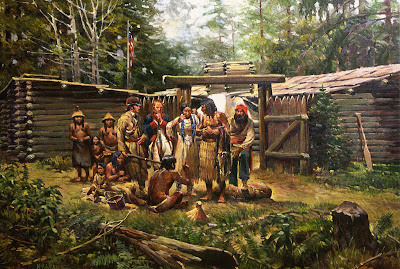
Typically, the trinkets and manufactured goods that serve as trade goods are worth very much to poor natives, so it is easy to trade a few small things for a large amount of provisions. When the expedition trades, the Provisions Supply automatically goes up a level, but there is a 10% chance that the Trade Supplies status goes down a level.

It is difficult to raise the Trade Supply level, since the expedition is far away from the cities of the Lunar Empire. One of the few ways to raise Trade Supply while in the wilderness is to find treasure. Any other increase in Trade Supply is likely to require roleplaying a specific plan or encounter.

The Trade Supply is also used as gifts to natives for diplomatic purposes, with a 10% chance of Trade Supply level reduction per diplomatic maneuver. Like with Provisions, a reduction of Trade can indicate a simple reduction of supply, or it sometimes it can mean theft or disaster has occurred.

Do you have any suggestions for this system?

Tuesday, July 21, 2009

M10

Picked up a M10 Fat Pack yesterday. I like what I've seen so far. The card names and art are a vast improvement over most everything since at least Mirrodin block.

One thing I've noticed about the art is that it seems unusually and intentionally dark in color and mood. Almost as if each piece was given an additional dark filter layer. Sometimes it gets too dark, but overall I'm satisfied with the art. I'll always prefer the art from the Alpha-to-Mirage era, but at least the Tempest-to-whatever era of art appears to be over.

But there are still some stinkers. Worst art in the set: Canyon Minotaur.

"Where is my center of gravity?"

"My canyon brethren are ridiculous."

I like the basic land art in the set:

Philippines?

North Dakota?

I don't buy or play enough Magic these days to think about creating tournament quality decks. For a challenge, I'm gonna build "Core Set only" 60 card decks. Who wants to play for ante?

I built this B-U-r deck out of the the eight booster packs that I have so far. The 40 card pack of basic land that comes with the Fat Pack is handy, but I still didn't get enough land of each color for just a two color deck. So I splashed a couple red cards.

1x Duress
1x Weakness
1x Drudge Skeletons
2x Mind Rot
3x Kelinore Bats
1x Vampire Aristocrat
1x Gravedigger
2x Tendrils of Corruption
1x Diabolic Tutor
1x Consume Spirit
2x Vampire Nocturnus
1x Xathrid Demon
11x Swamp

1x Lightning Bolt
1x Prodigal Pyromancer
3x Mountain

1x Ponder
1x Unsummon
1x Zephyr Sprite
1x Ice Cage
2x Essence Scatter
2x Negate
2x Merfolk Looter
1x Illusionary Servant
1x Wind Drake
1x Snapping Drake
2x Clone
1x Mind Control
2x Air Elemental
9x Island

Monday, July 20, 2009

Tarsh, Sartar, and Balazar

I've decided to go forward with the wilderness campaign and file the "Dark as a Dungeon" campaign away for some other decade.

A month or more ago I was thinking I'd be creating the wilderness expedition campaign from scratch. Then, I discovered the Griffin Mountain campaign book. The more I read it, the more I found it fit perfectly with my vision for this campaign. It will serve as "this side of the mountains"...the first half of the campaign. The second half of the campaign..."the other side of the mountains"...I plan to create from scratch, assuming the campaign gets that far.

Griffin Mountain is officially part of the Glorantha setting, for which almost four decades worth of books are available to study. It's quite overwhelming, so I'm ignoring almost all of it for this campaign and just focusing on the Griffin Mountain book. On the other hand, a wilderness expedition without any context is rather pointless, so I've found some material online that describes the PCs homeland and culture.

One of the neat things about the Glorantha setting is that many of the cultures are described in a series of documents called "Voices of Glorantha". They take the form of brief narratives of "What my father told me." and "What the priestess told me." A nice way to get an understanding of the PCs culture. Here is the Voice of the Tarshites.

Next is an informative summary of the Kingdom of Tarsh. This provides useful info on its towns and countryside, its internal politics and conflicts, and its external rivals and enemies.

With those introductary reads in mind, I now describe the context of the wilderness expedition:

The Kingdom of Tarsh is the southern border province of the Lunar Empire. Its situation and location means that Tarsh bears the brunt of angst against the empire: its own rebels, its barbarian neighbors, and beasts of chaos. It stands to reason that, of all Lunar citizens, Tarshites are the least softened by the corruption of prosperity that entrance into the empire has brought.


To the southeast of Tarsh is the Kingdom of Sartar, located in a region of monsters and barbarians called Dragon Pass. The empire has been attempting to conquer and hold this strategically important location for many generations. There is much adventure to be had here in the area of Dragon Pass, but it is not the focus of this campaign.


To the northeast of Tarsh is the primitive land of Balazar, which has long been too poor and barren for the empire to bother conquering it and bringing it into the fold. There is no reliable map of Balazar. Much of Balazar is unknown to the Lunars and unmapped. On the other hand, the natives have intimate knowledge of their realm.

Taking Balazar would provide a long-term strategic advantage against Sartar. Balazar and Sartar are separated by the nearly impassable Rockwood Mountains. The movement of an army over or through the mountains from Balazar to Sartar would be exceedingly difficult. Instead, the empire wants to determine if there is another way over the Rockwoods further to the east. Legend tells of one.

What lies over the mountains that far east is entirely unknown. There are rumors of a fertile land called The Hidden Greens. Surely such a land would hold many riches and be easy pickings. If nothing else, establishment of a connecting trade route would benefit the Lunar Empire. As mentioned above, the ultimate goal is to pressure Sartar from the east.

Enter...the PCs expedition.

Sunday, July 19, 2009

Truck Mix Disc: Juan Dela Cruz Band

A couple months ago I mentioned that I was planning to buy some CDs and DVDs in the Philippines. I found most of what I was looking for. Six movies and five albums for cheap. I put together this mix disc of my favorite songs from the bunch.

I don't understand the lyrics, of course, but it's good rak en rol. I usually just ask my wife what the titles mean, but I see that Google Translate can now partially translate Tagalog to English (it didn't do any a month or so ago).

1. Himig Natin
"Our Music". During our last night at the beach resort in Bohol, a pair of guitarists played a nice acoustic set in the restaurant area. I was about to request this song when they started playing it anyways.

2. Panahon
"Time". In Camiguin we were waiting on the beach for a boat to take us to Mantigue island. There was a videoke bar there and I was building up the courage to sing this song for the locals when the boat arrived and we left.

3. Inday
This is a girl's nickname. If I understand correctly, it is also can be used as a generic, and maybe slightly derogatory, way to address a girl. Kinda like "Missy", or something like that.

4. Balong Malalim
Sometimes when my wife feels the baby inside her moving around, she'll sing the first line of this song: Gusto n'yang mag swimming! Which means something like "She wants to go swimming!"

5. No Touch
The hook in this song goes: Sige na! Sige na! It means something like "Ok! let's go!" I had a t-shirt custom made with that lyric there in the Philippines, along with about a dozen other t-shirts.

6. Beep Beep
Whereas in some places of the world beeping your car horn generally means "Watch out, asshole!", in the Philippines it generally means "Hello. Sorry about my haste. Please excuse me. Thank you!" So that cacophony of car horns, bike horns, truck horns, and jeepney horns at every intersection there is kinda like a big friendly get together.

7. Kahit Anong Mangyari
"No matter what happens"

8. Todo Mo Na
This song is just a groovin' jam and every once in awhile they sing out: Todo Mo Na! which kinda means "Don't stop!". So then they keep on jammin'.

9. Rock & Roll Sa Mundo
In Tagalag, like in Spanish, "mundo" means "world".

10. Nakatagong Mata
"Hidden Eyes"

11. Pagod Sa Pahinga
"Tired of Resting" I might be one of the few people ever to realize that this gentle instrumental is exactly the same song as John Hartford's "Presbyterian Guitar".

12. Palengke
"Market"

13. Naglalakbay
"Passing Through"

14. Laki Sa Layaw
"Grew up Pampered" This song popularized the word "jeproks", which nobody seems to know the precise meaning of.

15. Mr. Kenkoy
Hoy hoy hoy. "Mr. Funnyman"

16. Kayabangan
"Arrogance"

17. Tulungan Natin
"Let's Help"

18. Langit
"Heaven"

19. Legs
A member of Juan Dela Cruz later formed Hagabis, a disco band with a sound similar to...The Village People. This funky song largely consists of the band yelling "Legs! Legs! Legs!" followed by various phrases that mean something like "They are blinding me." and "They are melting me." Fun singalong.